Shame and the Anti-Feminist Backlash by Sharon Crozier-De Rosa
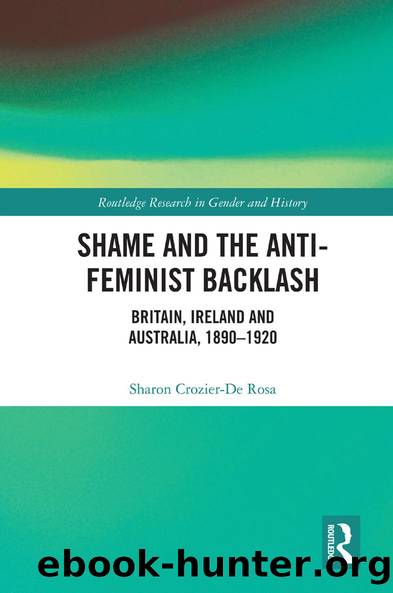
Author:Sharon Crozier-De Rosa [Rosa, Sharon Crozier-De]
Language: eng
Format: epub
ISBN: 9780367867393
Barnesnoble:
Publisher: Taylor & Francis
Published: 2019-12-10T00:00:00+00:00
5âWar and the Dishonourable British Feminist
In 1915, the British Anti-Suffrage Review (the Review) exposed the presence of the diabolical vampirish nurseâthe woman, masquerading as a carer, who preyed on the pathetic gratitude of the broken and bleeding soldier in the field hospitals to secure for herself and her fellow feminists a promise to vote for woman suffrage should her patient survive the journey back to the homeland. The source of the leak was none other than Mrs Millicent Fawcett, leader of the National Union of Woman Suffrage Societies (NUWSS). Under Fawcettâs direction, the NUWSS had raised an enormous £500,000 to support 14 all-female wartime hospital units.1 It was, therefore, responsible for sending a significant number of female nurses to the front. This was certainly a laudable act of patriotism and yet, in an interview with the Liverpool Daily Post, Fawcett revealed that her nurses were managing to get a word in on the suffrage question while attending wounded soldiers. More than that, they were persuading these soldiers to promise that they would do what they could to secure the female franchise when the war was over. In the first place, the Review sternly objected to suffrage agitation when a truce had been agreed between the government and feminists at the outbreak of the war. Yet here were suffragist nurses acting with impunity. Secondly, accepting that feminists were carrying on with their campaign, the Review doubted that this political work could be classified as âhonest propagandaâ. Wounded soldiers had impaired capabilities. They could not examine important political issues in a rational manner. âIs there not something very unhallowed in exploiting in this fashion the natural gratitude of a wounded warrior for a kind lady who is nursing him?â the paper asked. It answered in the affirmative, âIt is hitting Tommy politically âwhen he is downâââ.2 Altogether, the political activism of wartime nurses was a ânauseating spectacleâ. It was tantamount to âtreachery to the public and blackmail on the troopsâ.3
As if this resort to political expediency was not bad enough, it seemed that Mrs Fawcett was actually proud of her nursesâ endeavours. The unbelievable thing, the Review pronounced, is âthe naiveté with which Mrs Fawcett glories in the shameâ.4 It did not occur to her that there was anything âillegitimate or dishonourableâ in the actions of her followers.5 This led the paper to declare that wartime feminists were incapable of embodying the masculine emotional virtues necessary for the proper conduct of politics, especially in a time of war. They had proven that they could not conduct themselves according to masculine codes of honourâdrawing, as these did, on concepts of integrity, honesty, and fairnessâthat guided the gentlemanâs dealings in the worlds of business and politics. These codes also directed menâs relations with each other during times of war. These women were, therefore, unmanly navigators of the male political sphere, especially the wartime political sphere.
In this chapter, I argue that anti-suffragistsâ bitter resentment of pre-war suffragist behaviour, particularly militant behaviour, and their suspicions about
Download
This site does not store any files on its server. We only index and link to content provided by other sites. Please contact the content providers to delete copyright contents if any and email us, we'll remove relevant links or contents immediately.
| Anthropology | Archaeology |
| Philosophy | Politics & Government |
| Social Sciences | Sociology |
| Women's Studies |
Cecilia; Or, Memoirs of an Heiress — Volume 1 by Fanny Burney(32654)
The Great Music City by Andrea Baker(32621)
Cecilia; Or, Memoirs of an Heiress — Volume 2 by Fanny Burney(32025)
Cecilia; Or, Memoirs of an Heiress — Volume 3 by Fanny Burney(32005)
We're Going to Need More Wine by Gabrielle Union(19121)
All the Missing Girls by Megan Miranda(16411)
Pimp by Iceberg Slim(14711)
For the Love of Europe by Rick Steves(14659)
Bombshells: Glamour Girls of a Lifetime by Sullivan Steve(14152)
Talking to Strangers by Malcolm Gladwell(13474)
Norse Mythology by Gaiman Neil(13472)
Fifty Shades Freed by E L James(13305)
Mindhunter: Inside the FBI's Elite Serial Crime Unit by John E. Douglas & Mark Olshaker(9447)
Crazy Rich Asians by Kevin Kwan(9360)
The Lost Art of Listening by Michael P. Nichols(7568)
Enlightenment Now: The Case for Reason, Science, Humanism, and Progress by Steven Pinker(7369)
The Four Agreements by Don Miguel Ruiz(6852)
Bad Blood by John Carreyrou(6684)
Weapons of Math Destruction by Cathy O'Neil(6387)
